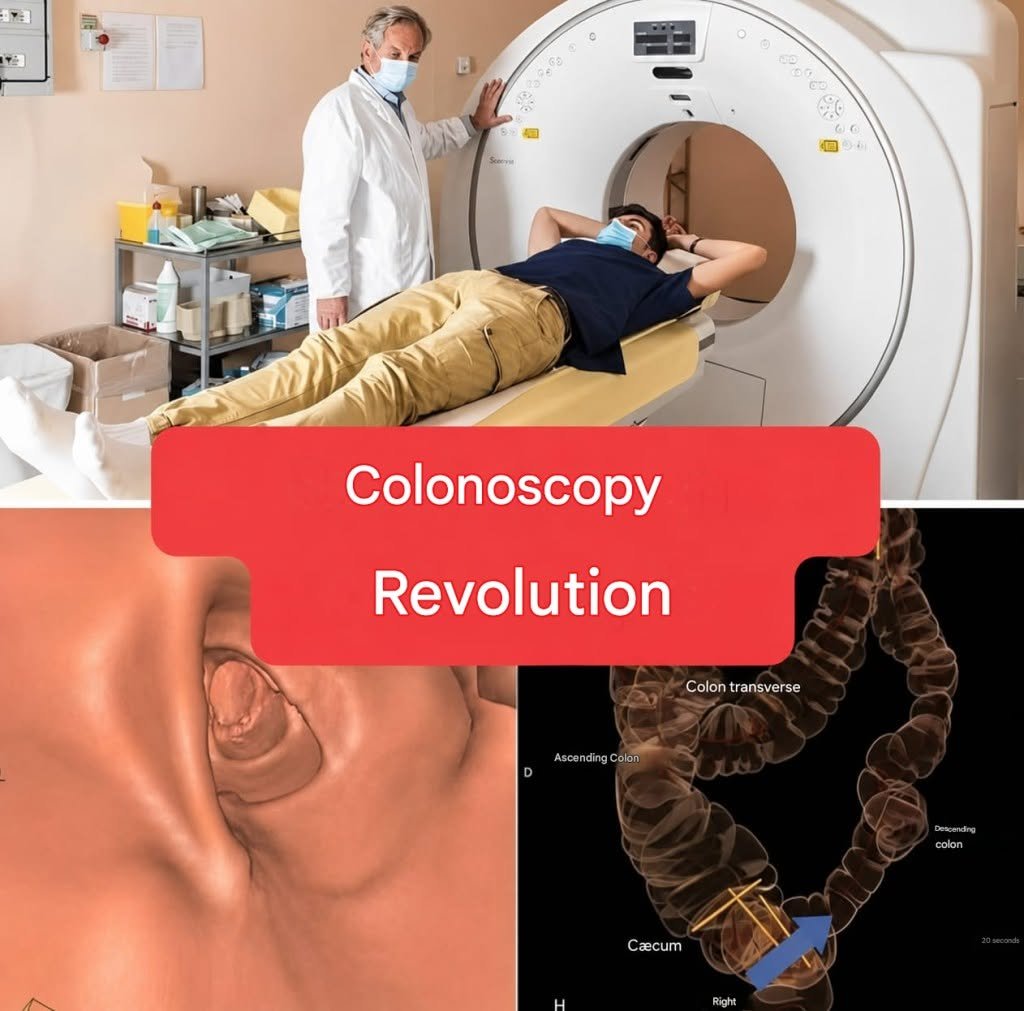
While headlines proclaiming the “end of invasive colonoscopies” often make the rounds, the medical reality is a bit more nuanced. Recent advancements in non-invasive screening options—such as capsule endoscopies, AI-driven virtual colonoscopies, and advanced stool DNA tests—are revolutionizing early detection, but traditional colonoscopy remains an irreplaceable tool in gastroenterology.
Non-Invasive & Less-Invasive Colonoscopy Alternatives
Medical technology has introduced several highly accurate methods to screen the colon without a traditional flexible endoscope:
1. Video Capsule Endoscopy (“PillCam”)
-
How It Works: You swallow a small, vitamin-sized capsule equipped with light sources and tiny wireless cameras. As it naturally moves through your digestive tract over 8 to 12 hours, it takes thousands of high-resolution images and transmits them to a recorder worn on a belt.
-
Pros: Completely non-invasive, pain-free, and requires no sedation.
-
Cons: Bowel preparation is still required so the camera gets a clear view. Additionally, if the capsule detects a polyp or abnormality, a traditional colonoscopy must still be performed to remove it.
2. CT Colonography (“Virtual Colonoscopy”)
-
How It Works: Advanced 3D computed tomography (CT) scans capture detailed images of the entire colon and rectum from outside the body.
-
Pros: Quick (takes roughly 10–15 minutes), requires no conscious sedation, and can view organs surrounding the colon.
-
Cons: Still requires full laxative bowel preparation and gentle inflation of the colon with air via a small tube. It involves low-dose radiation exposure, and any detected polyps require a follow-up therapeutic colonoscopy.
3. Advanced Stool-Based DNA & Blood Tests (e.g., Cologuard, Guardant Shield)
-
How It Works: Stool tests evaluate human DNA markers and microscopic traces of blood (fecal immunochemical test / FIT) shed by precancerous polyps or tumors. Newer blood tests (cell-free DNA blood draws) detect tumor DNA circulating in the bloodstream.
-
Pros: Completely non-invasive, done at home or via a simple routine blood draw, with no dietary restrictions or laxative prep required beforehand.
-
Cons: These are strictly screening tools, not preventive interventions. They cannot detect flat, small polyps as reliably, and a positive result mandates a diagnostic colonoscopy.
Why Traditional Colonoscopy Remains the “Gold Standard”
While non-invasive options excel at detecting tissue changes, traditional colonoscopy is unique because it is both a diagnostic tool AND an active preventive treatment:
-
Immediate Polyp Removal (Polypectomy): During a traditional colonoscopy, if the physician identifies a precancerous polyp, they can snip or cauterize it immediately through the scope, stopping colon cancer before it ever starts.
-
Tissue Biopsies: Suspicious areas or inflammatory bowel tissue (such as Crohn’s or Ulcerative Colitis) can be sampled on the spot for laboratory analysis.
Comparison of Colon Screening Methods
| Screening Method | Invasive Level | Requires Laxative Prep? | Requires Sedation? | Can Remove Polyps? |
| Traditional Colonoscopy | Invasive | Yes | Yes (Conscious/Deep) | Yes (Immediate) |
| Capsule Endoscopy | Minimal (Pill) | Yes | No | No (Requires follow-up) |
| CT Virtual Colonoscopy | Minimal (External Scan) | Yes | No | No (Requires follow-up) |
| Stool DNA / Blood Test | Non-invasive | No | No | No (Requires follow-up) |
The Future: AI & Micro-Robotics
Research is accelerating toward even more advanced alternatives:
-
Self-Propelling Magnetically Guided Capsules: Radiologists can navigate swallowed capsules through the stomach and colon in real time using external magnetic wands.
-
AI-Assisted Optical Biopsies: Artificial intelligence algorithms paired with advanced light technology can assess whether a tissue lesion is malignant without physical sampling.
Non-invasive tests are dramatically increasing overall screening rates by giving patients comfortable alternatives. However, for the foreseeable future, traditional colonoscopy remains the indispensable second step whenever an abnormality is found.
