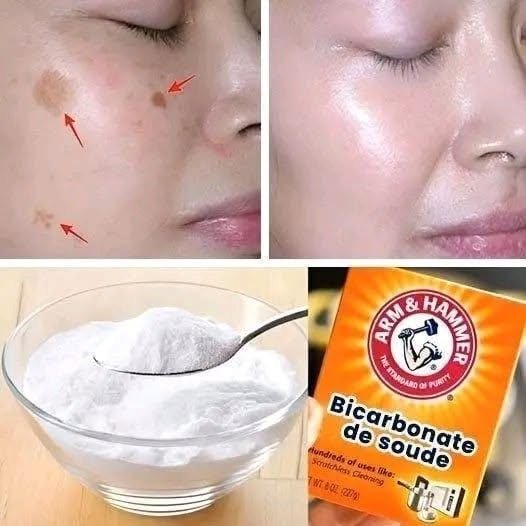
Clinical Reality Check: Baking soda (sodium bicarbonate) cannot “erase” age spots (solar lentigines). Age spots are focal accumulations of melanin produced by UV-damaged melanocytes sitting in the basal layer of the epidermis. Scrubbing or applying an alkaline (~pH 9) abrasive paste strips the stratum corneum, causes chemical/irritant contact dermatitis, and frequently worsens pigmentation via post-inflammatory hyperpigmentation (PII/PIH). (Note: Baking soda facial safety hazards were previously established; the dermatological reality for pigment remains identical.)
The “4 Ways” Myth vs. Dermatological Reality
| Viral “Method” | Claimed Action | Dermatological Reality |
| 1. Baking Soda + Lemon Juice Scrub | “Acid and alkaline neutralize to bleach spots” | Destroys skin barrier, causes phytophotodermatitis/acid-base micro-trauma, and dramatically spikes risk of chemical burn or rebound hyperpigmentation. |
| 2. Baking Soda + Coconut Oil Paste | “Buffs away dead pigmented cells” | Physical grit scours fragile epidermis; coconut oil is comedogenic for many skin types and traps irritation. |
| 3. Baking Soda + Hydrogen Peroxide | “Oxidizes deep age spots” | Hydrogen peroxide is a cytotoxic oxidant that causes epidermal necrosis, erythema, and barrier destruction without safely targeting melanocytes. |
| 4. Daily Baking Soda Wash (“Gentle Polish”) | “Gradually fades spots over 2 weeks” | Chronic alkaline stripping (~pH 9 vs. acid mantle pH 4.5–5.5) induces dysbiosis, chronic micro-fissuring, and persistent solar lentigo persistence. |
Why Baking Soda Fails Against Melanocytes
-
Depth Mismatch: Solar lentigines reside at the epidermal-dermal junction. Surface abrasive scouring only damages the dead/dying outer cornified layer.
-
Melanin Pathway Inaction: Fading melanin requires blocking tyrosinase enzyme activity, accelerating cellular turnover safely, or targeting melanosome transfer—mechanisms sodium bicarbonate completely lacks.
Evidence-Based Alternatives for Solar Lentigines (Age Spots)
-
Inhibitors: Azelaic acid (10–15%), Niacinamide (5%), Kojic acid, or Alpha-arbutin.
-
Turnover / Cell Renewal: Low-strength retinoids (adapalene, retinol) or buffered AHAs (glycolic/lactic acid).
-
Clinical Gold Standards: Q-switched or picosecond lasers, cryotherapy, or prescription hydroquinoids (under dermatology supervision).
-
The Non-Negotiable Prerequisite: Daily broad-spectrum SPF 30+ to prevent existing UV-driven melanocyte signaling from darkening spots further.
Safety Red Line: Avoid combining baking soda with lemon juice or hydrogen peroxide on facial skin. Chemical burns, persistent stinging, and paradoxical dark patches (especially in Fitzpatrick skin types III–VI) are high-probability outcomes.
Are you evaluating these spots to confirm they are benign solar lentigines, or looking for a safe topical fading regimen?
