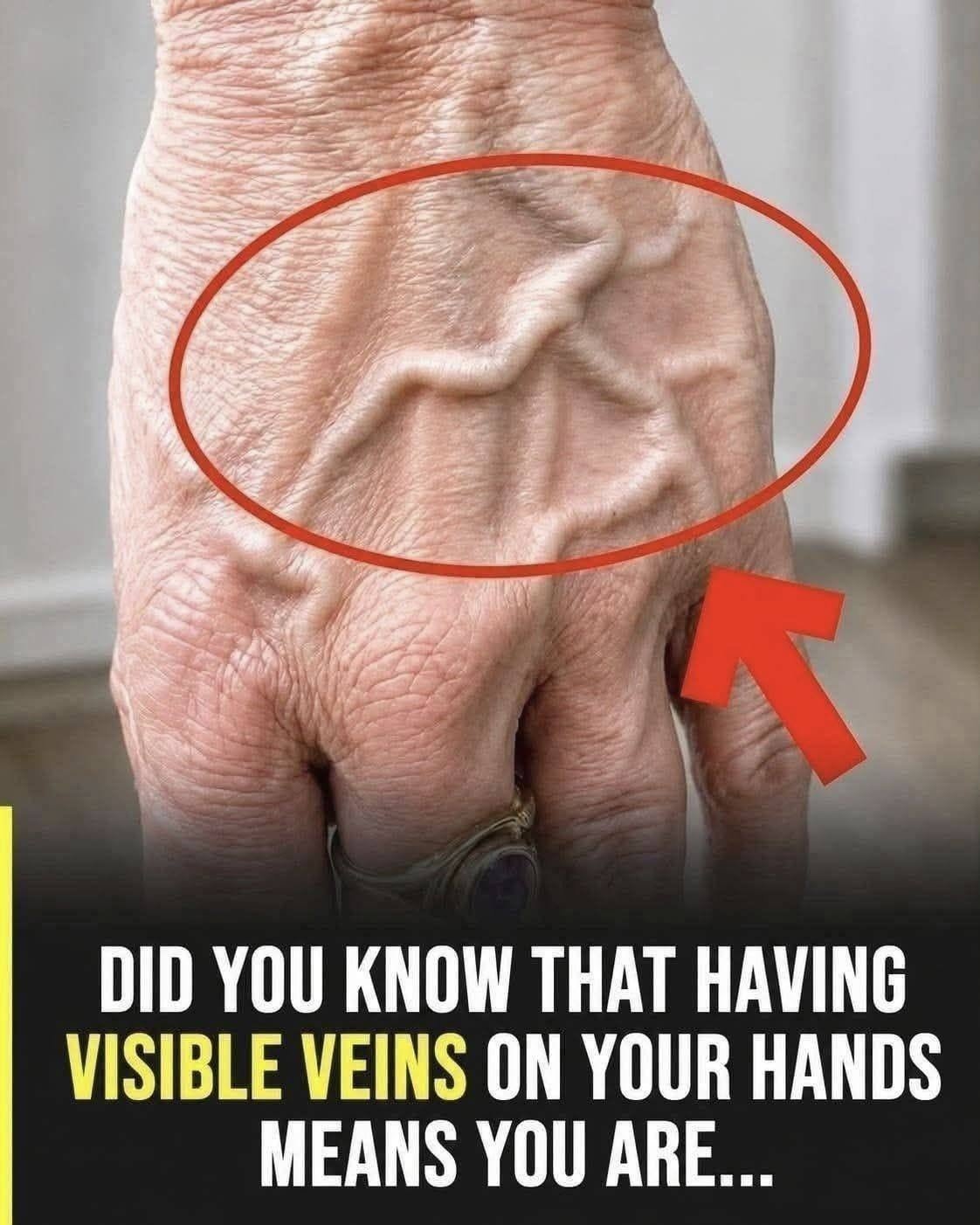
That classic health and fitness headline—“Did you know that having visible veins means you are…”—is a brilliant hook because it preys on our endless fascination with what our bodies are trying to tell us. Depending on which corner of the internet you wander into, visible veins are used to claim that you are supremely fit, dangerously dehydrated, uniquely intelligent, or suffering from a hidden medical issue.
In reality, the prominence of your veins has very little to do with secret personality traits and everything to do with basic anatomy, biology, and physics.
From a physiological standpoint, here is what your visible veins are actually telling you about your body:
The Real Reasons Veins Become Visible
-
Low Body Fat Percentage (The Fitness Factor):
-
The Biology: Everyone has veins running all over their body. However, they are separated from the surface by a layer of subcutaneous fat. If a person has a lower body fat percentage, that insulating layer of fat is thinner, allowing veins to sit closer to the surface and show through the skin like a road map. This is why endurance athletes and bodybuilders often have highly prominent veins.
-
-
Thin Skin and Biological Aging:
-
The Biology: As we age, our skin naturally loses collagen, elastin, and subcutaneous fat, causing it to become thinner and more translucent. Coupled with the natural weakening of vein walls over time (which can cause them to dilate or bulge slightly), veins on the hands, arms, and temples become much more noticeable simply as a byproduct of aging.
-
-
High Blood Pressure and Vasodilation (Heat and Exercise):
-
The Biology: When you exercise, your muscles require more oxygen, causing your heart rate and blood pressure to rise. To help dissipate the heat generated by working muscles, your blood vessels dilate (widen) and push closer to the skin’s surface. Similarly, hot weather causes your blood vessels to expand, making veins pop more than they would on a cold day.
-
-
Genetics:
-
The Biology: Just like eye color or height, some people are simply born with translucent skin or superficial vein networks that sit closer to the surface. You can have a higher body fat percentage and still have very visible hands or feet purely because of your genetic blueprint.
-
When Visible Veins Do Warrant Medical Attention
While having naturally prominent veins from fitness, age, or genetics is totally harmless, certain types of visible veins are a signal of an underlying medical condition:
-
Varicose Veins: If the tiny one-way valves inside your leg veins weaken, blood can flow backward and pool, causing veins to twist, bulge, swell, and turn dark purple or blue. This is known as chronic venous insufficiency and can cause aching, heaviness, or swelling in the legs.
-
Spider Veins (Telangiectasias): These are tiny, damaged capillaries that appear close to the surface of the skin in a web-like pattern, often triggered by hormonal shifts, sun damage, or prolonged standing.
The Takeaway
Seeing your veins doesn’t mean you possess a mysterious health status or a hidden superpower; it usually just means you have low body fat, thin skin, warm weather, or good old-fashioned genetics at play.
Have you noticed your veins becoming more prominent recently, or were you tracking down the punchline to a specific viral headline?
