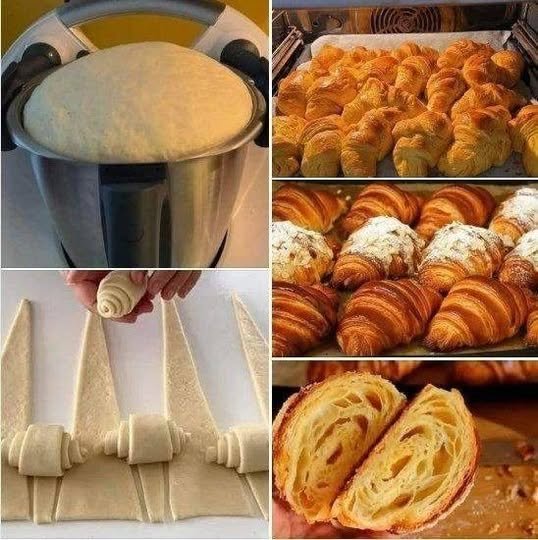
Authentic Homemade French Croissants
Making traditional French croissants from scratch is an ultimate baking labor of love. It requires patience and precision, but the reward is layers of shatteringly crisp, buttery pastry with a soft, honeycomb interior.
Ingredients
For the Detrempa (Dough):
-
3 ½ cups (420g) all-purpose flour (or a mix of half bread flour, half all-purpose for extra strength)
-
¼ cup (50g) granulated sugar
-
2 ¼ tsp (7g / 1 packet) active dry yeast or instant yeast
-
1 ½ tsp fine sea salt
-
¾ cup (180ml) cold whole milk
-
¼ cup (60ml) cold water
-
2 tbsp (30g) unsalted butter (melted and cooled)
For the Beurre de Tourage (Butter Block):
-
1 cup (226g / 2 sticks) high-quality unsalted European-style butter (82% fat content or higher has less water and yields the best layers)
-
2 tbsp all-purpose flour (dusted lightly to prevent melting)
For the Egg Wash:
-
1 large egg beaten with 1 tbsp milk and a tiny pinch of salt
Step-by-Step Instructions
Phase 1: Making the Dough
-
Mix the Dough: In a large bowl, whisk together the flour, sugar, yeast, and salt. Add the cold milk, cold water, and melted butter. Mix with a spatula or hook attachment until a rough dough forms.
-
Knead & Chill: Turn the dough onto a lightly floured surface and knead for about 3 to 4 minutes until smooth (do not over-develop the gluten, as it needs to remain extensible). Shape into a neat rectangle, wrap tightly in plastic wrap, and refrigerate for at least 4 hours (or overnight).
Phase 2: Preparing the Butter Block
-
Shape the Butter: Pound the cold sticks of butter with a rolling pin between two sheets of parchment paper, shaping it into a neat 6×6-inch square.
-
Chill: Dust with the 2 tablespoons of flour to stabilize it, wrap it up, and place it in the refrigerator until it matches the firm, pliable consistency of your chilled dough.
Phase 3: Lamination (The Butter Lock & Turns)
-
Lock-In: Roll out your chilled dough on a lightly floured surface into a 6×12-inch rectangle. Place the butter square on the lower half of the dough, folding the upper half of the dough over it to completely encase the butter. Pinch the edges to seal.
-
First Single Turn: Roll the dough gently into an 8×20-inch rectangle. Brush off any excess flour. Fold the bottom third up, and the top third down (like a business letter). Wrap in plastic and chill in the fridge for 45 minutes.
-
Second and Third Turns: Repeat this rolling and folding process (a “turn”) two more times, chilling the dough for 45 minutes between each turn to keep the butter cold and distinct from the dough layers.
Phase 4: Shaping and Proofing
-
Roll Out: After your final chill, roll the laminated dough out on a lightly floured surface into a long rectangle roughly 8 inches wide by 30 inches long, maintaining an even thickness of about ¼ inch.
-
Cut Triangles: Cut the dough lengthwise down the center to create two long strips, then cut triangles with a base of about 4 to 5 inches.
-
Shape: Make a tiny 1-inch slit at the center of the base of each triangle. Gently stretch the base corners slightly, then roll the triangle up firmly from the base to the tip, tucking the tip underneath the croissant. Place on a parchment-lined baking sheet.
-
Proof: Let the shaped croissants rise at room temperature (around 70°F to 75°F / 21°C to 24°C) for 2 to 3 hours. They are ready when they look puffy, jiggle slightly when the pan is shaken, and show visible layers. (Do not let them get too warm, or the butter will leak out!)
Phase 5: Baking
-
Preheat: Preheat your oven to 400°F (200°C).
-
Glash and Bake: Brush the proofed croissants gently with your egg wash. Bake at 400°F for 15 minutes, then drop the temperature to 375°F (190°C) and bake for another 10 to 12 minutes until deeply golden brown and crisp.
-
Cool: Transfer to a wire rack and let cool completely before eating.
Pro Tips for Success
-
Keep Everything Cold: If at any point during lamination the butter feels like it is melting or oozing out of the dough, immediately wrap it and put it in the fridge for 30 minutes to firm back up.
-
European Butter: High-fat European butter contains less water than standard American butter, making it much more pliable and resistant to melting during the rolling process.
Would you like tips on how to freeze unbaked croissants to bake fresh later, or are you ready to take on the lamination process?
