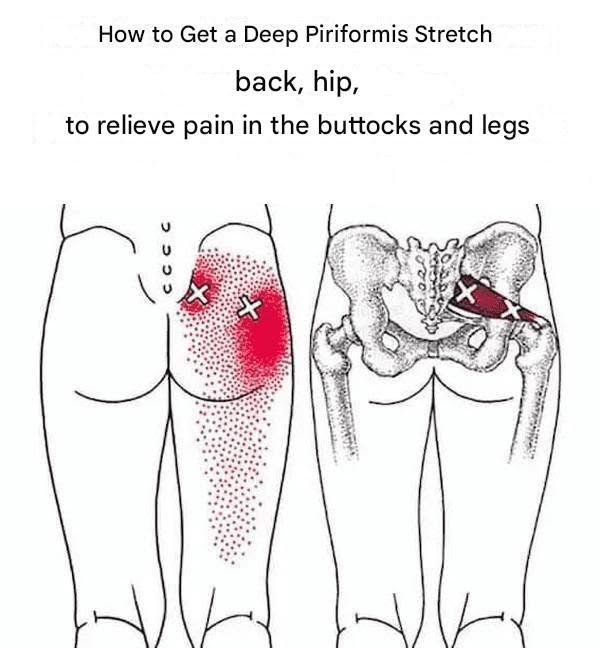
Understanding the Piriformis
The piriformis is a small, deep muscle running from the lower spine through the buttock to the top of the femur. When tight or spasmodic, it can compress or irritate the adjacent sciatic nerve, mimicking sciatica (referred to as piriformis syndrome).
Safety Note: If a stretch sharpens radiating leg pain or numbness, stop immediately. Deep gluteal stretches should feel like a deep, tolerable tension—never sharp nerve compression.
Top Deep Piriformis Stretches
1. Figure-4 Stretch (Supine / Lying Down)
Best for back-friendly, controlled depth.
-
Setup: Lie on your back with knees bent and feet flat on the floor.
-
Action: Cross your right ankle over your left knee (forming a “4”). Reach through the opening to grab the back of your left thigh (or shin, if flexible).
-
Deepen: Gently pull the left leg toward your chest while keeping your tailbone heavy on the floor and your right knee pressing outward.
-
Hold: 30–45 seconds per side, 2–3 times.
2. Seated Figure-4 (Chair Stretch)
Best for office or midday relief.
-
Setup: Sit upright near the edge of a sturdy chair.
-
Action: Cross your right ankle over your left knee. Keep your spine long and hinge forward slightly from the hips (do not round your lower back).
-
Deepen: Gently press down on the inner right knee while leaning torso forward until a deep glute stretch is felt.
-
Hold: 30–45 seconds per side.
3. Pigeon Pose (Modified / Floor)
Best for maximum depth (use a block or bolster under the hip if tight).
-
Setup: Start on hands and knees. Bring your right knee forward behind your right wrist, angling your right foot toward your left hip/wrist.
-
Action: Extend your left leg straight back behind you, squaring your hips toward the floor.
-
Deepen: Lower onto your forearms or fold forward over your front shin. Support the right hip with a yoga block if it hovers high off the floor.
-
Hold: 45–60 seconds per side.
Complementary Relief Strategies
Stretching alone won’t fix chronic entrapment if underlying mechanics or sitting habits drive the tightness:
-
Release trigger points: Use a lacrosse ball or foam roller gently on the deep glute for 60–90 seconds, rolling around rather than directly hammering an inflamed sciatic nerve zone.
-
Address sitting posture: Prolonged compression on the glutes keeps the piriformis ischemic and hypertonic. Stand up every 45–60 minutes.
-
Hip external rotator vs. stabilizer balance: Strengthen weak hip abductors (gluteus medius) with side-lying clam shells or monster walks to reduce over-reliance on the piriformis.
Are you feeling this discomfort more on one specific side, or is it triggered by prolonged sitting or running?
