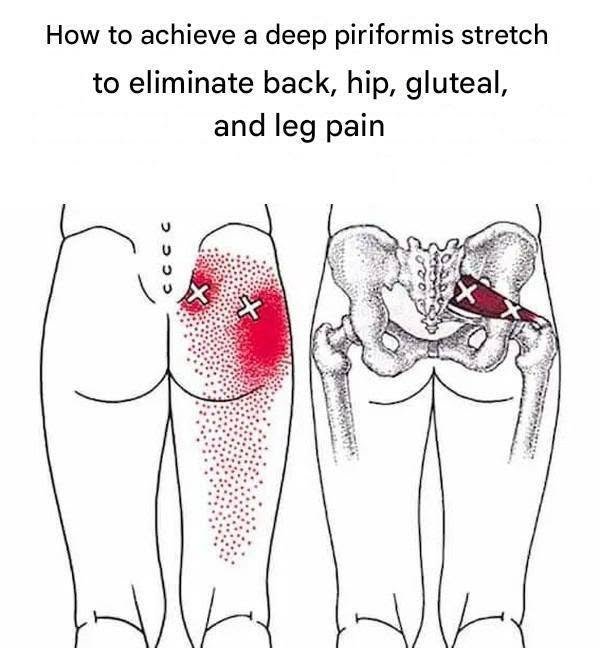
> **Clinical Reality Check:** “Piriformis syndrome”—where the piriformis muscle compresses or irritates the adjacent sciatic nerve, causing deep buttock pain and radiating leg symptoms—is frequently overdiagnosed. **True piriformis syndrome is relatively rare (~6–8% of sciatica cases)**; the vast majority of sciatic nerve pain originates from lumbar spine pathology (disc herniation, foraminal stenosis, or facet irritation). Passive stretching helps *only* if the muscle is genuinely hypertonic/shortened; aggressive stretching of an already inflamed musculotendinous junction or misdiagnosing a lumbar disc can worsen symptoms.
—
## Piriformis Claims vs. Clinical Reality
| Common Belief / Myth | Clinical Reality | Why It Matters |
| — | — | — |
| **”Stretching fixes all sciatica / shooting leg pain”** | Stretching only relieves nerve irritation if the piriformis itself is tight and clamping the nerve. | Stretching a lumbar nerve root compression (disc herniation) won’t fix the source and can aggravate spine flexion intolerance. |
| **”Aggressive, deep-pain stretching is best (‘no pain, no gain’)”** | Deep gluteal pain involves tendinopathic insertion points or acute nerve stretch irritation. | Aggressive forcing reproduces microtrauma and central sensitization of deep gluteal pain. |
| **”Stretching alone cures piriformis syndrome”** | Muscular hypertonicity is usually secondary to pelvic instability, weak gluteus medius, or prolonged sitting shear loads. | Without addressing hip stabilization and sitting ergonomics, tight/hypertonic piriformis patterns return immediately. |
—
## 3 Safe, Evidence-Informed Movements
| Movement | Execution Focus | Purpose |
| — | — | — |
| **1. Gentle Supine Figure-4** | Lie on back, cross affected ankle over opposite knee, gently draw opposite thigh toward chest *only until a mild-to-moderate stretch is felt deep in the buttock*. Hold 20–30s. | Low-load elongation of external rotators without lumbar spinal flexion or high shear. |
| **2. Seated Piriformis Cross-Body Stretch** | Sit upright in a chair, cross affected ankle over opposite knee, hinge slightly forward from the *pelvis/hips* (keep spine neutral, do not round lower back). | Isolates deep external rotator stretch while maintaining spinal safety. |
| **3. Side-Lying Clamshell / Isometric External Rotation** | Controlled opening of top knee with heels touching, or seated banded isometric external rotation. | Addresses the root mechanical weakness (gluteal control/stability) that forces the piriformis to overwork. |
—
## Principles of Long-Term Relief
* **Reduce Static Compression:** Prolonged hard-surface sitting squashes the gluteal/piriformis bed against the sciatic nerve. Use micro-breaks (stand/walk 2 minutes every 45 mins) or a cushioned cutout.
* **Screen the Spine First:** If back extension/flexion changes your leg symptoms, or if coughing/sneezing shoots pain down the leg, the lumbar spine is the primary driver.
> **Safety Red Lines:** Seek prompt medical evaluation if you experience **progressive motor weakness (e.g., foot drop/tripping), saddle anesthesia (numbness in groin/buttocks touching a saddle), or bowel/bladder incontinence** (emergency spine red flag). Stop stretching immediately if it sharpens or peripheralizes radiating leg pain.
Are you experiencing sharp pain shooting past the knee/calf, or a deep, localized ache right in the center of one buttock—especially after sitting?
