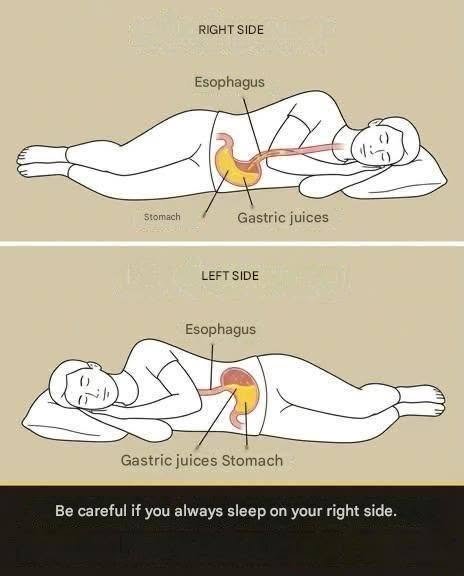
That classic wellness hook—“Remember that if you always sleep on your right side, you…”—is a staple of internet health folklore. It relies on a cliffhanger designed to make you panic that a simple, comfortable sleeping posture is secretly wrecking your internal organs.
When you strip away the dramatic internet mystery and look at clinical gastroenterology and human anatomy, the reality is far less alarming: No normal sleeping position will damage your organs or cause sudden health disasters.
However, sleeping position can play a minor, specialized role for certain pre-existing conditions—most notably acid reflux.
Here is what is actually happening physiologically regarding side sleeping, what the science says about the left versus the right, and why you don’t need to stress over your pillow setup:
The Reality of Right-Side vs. Left-Side Sleeping
-
The One Proven Difference: Acid Reflux (GERD):
-
The Anatomy: Gastroenterology studies have consistently shown that your stomach sits slightly to the left side of your upper abdomen, and the junction where your esophagus meets your stomach sits below the level of gastric acid when you lie on your left.
-
The Mechanism: If you suffer from frequent heartburn or gastroesophageal reflux disease (GERD), sleeping on your right side or flat on your back can allow gravity to pool stomach acid against the lower esophageal sphincter, increasing the likelihood of nighttime burning. Conversely, sleeping on your left side keeps the gastric junction above the acid line, utilizing gravity to reduce reflux episodes.
-
-
What About the Heart and Organs?
-
Internet myths frequently claim that right-side sleeping crushes your heart or strains your circulatory system. Clinical cardiologists have repeatedly debunked this: your heart is securely suspended within the mediastinum and protected by the ribcage, and routine side sleeping does not damage cardiac function. While pregnant individuals are often advised to favor their left side late in pregnancy to optimize blood flow through the inferior vena cava, for the general population, the body naturally shifts positions multiple times a night without issue.
-
The Clinical Takeaway
You do not need to lie awake at night stressing over whether you rolled onto your right side. If you wake up comfortable and pain-free, your body is doing fine. The only people who need to actively engineer their sleep posture are those dealing with specific chronic issues like severe GERD (who benefit from left-side sleeping or elevating the head of the bed) or obstructive sleep apnea (who benefit from avoiding sleeping flat on their backs).
Are you managing a specific symptom like nighttime heartburn, or tracking down another piece of sleep-related wellness media?
