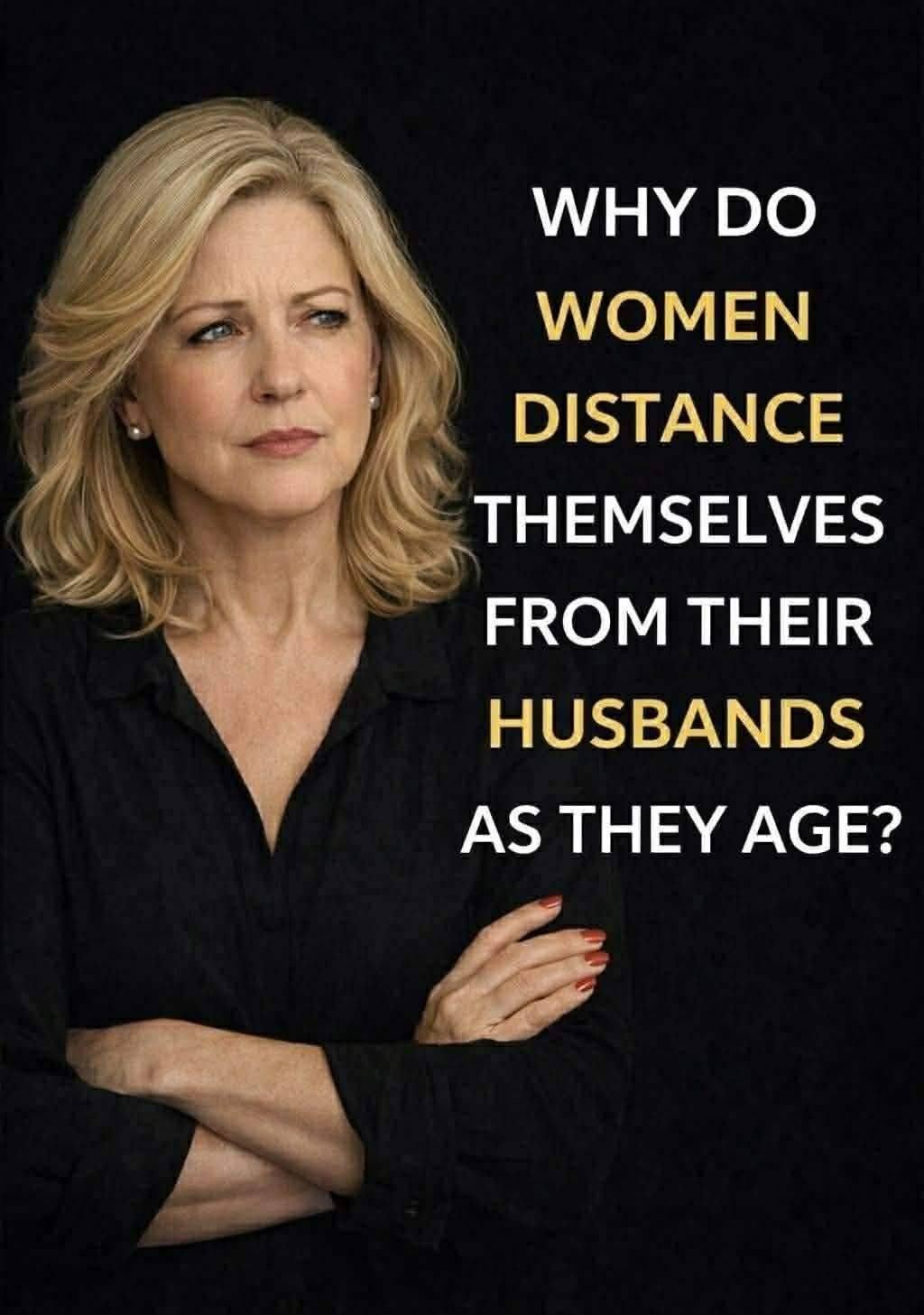
The question of why some women distance themselves from their husbands later in life touches on a complex intersection of psychology, biology, sociology, and changing relationship dynamics. Rather than a single cause, this distancing is often the result of an accumulation of life stages, shifting roles, and evolving emotional needs.
Relationship researchers, sociologists, and family therapists point to several key factors that contribute to this phenomenon:
1. The “Empty Nest” and the Mirror of Retirement
-
The Shift: For decades, many couples’ lives revolve around raising children, managing household logistics, and balancing busy careers. Once children leave home and retirement arrives, the day-to-day distractions disappear.
-
The Impact: When the busyness fades, couples are suddenly left staring at each other in a quiet house. If emotional intimacy, shared interests, or effective communication were neglected over the years, the silence can feel glaring, leading wives to pull back as they realize how disconnected they have become.
2. The Disproportionate Burden of Emotional and Mental Labor
-
The Shift: Sociological studies consistently show that women often carry the primary load of “emotional labor”—managing family schedules, remembering birthdays, anticipating household needs, and orchestrating social calendars.
-
The Impact: Over decades, carrying this invisible mental load while also managing work or personal responsibilities can lead to profound burnout. By the time they reach midlife or older, some women experience a sense of exhaustion and resentment if they feel their partner has acted more like an additional dependent than an equal teammate. Distance becomes a way to reclaim personal energy and peace.
3. Hormonal and Physiological Transitions (Perimenopause and Menopause)
-
The Shift: Midlife brings significant hormonal shifts during perimenopause and menopause, accompanied by physical symptoms like fatigue, sleep disruption, mood fluctuations, and changing body image.
-
The Impact: Psychologically, this transition often triggers a period of profound introspection. Many women experience what psychologists call a “midlife re-evaluation”—a time when they ask themselves, “What do I want for the rest of my life?” If a husband is unsupportive, dismissive, or unwilling to navigate these physical and emotional changes with empathy, wives frequently withdraw emotionally to protect their own well-being.
4. Diverging Personal Growth and Changing Priorities
-
The Shift: People change significantly over a span of 20, 30, or 40 years of marriage.
-
The Impact: While some couples grow together, others grow in entirely different directions. A woman may develop new hobbies, deeper friendships, spiritual interests, or personal confidence later in life, while her partner may remain static. If the husband is not interested in her new passions—or worse, tries to diminish them—she may find greater emotional fulfillment in her social circle and distance herself from the marriage.
5. The “Quiet Quit” of Long-Term Relationships
-
The Shift: Sociologists note that women initiate the vast majority of divorces later in life (often referred to in research as “gray divorce”).
-
The Impact: Before a couple reaches that point, there is often a long phase of emotional distancing. If years of trying to communicate needs, resolve conflicts, or ask for emotional support have led nowhere, a woman may emotionally “check out.” This quiet withdrawal is often a defense mechanism or a preliminary step toward independence.
The Takeaway: Emotional distance in older marriages is rarely about a single sudden event; it is usually the culmination of unmet emotional needs, changing roles, and decades of unexpressed friction. However, with mutual self-awareness, couples counseling, and a willingness from both partners to listen and adapt, many relationships successfully bridge that gap and rediscover connection.
Are you looking at this from a psychological perspective, or exploring relationship dynamics for a specific situation?
