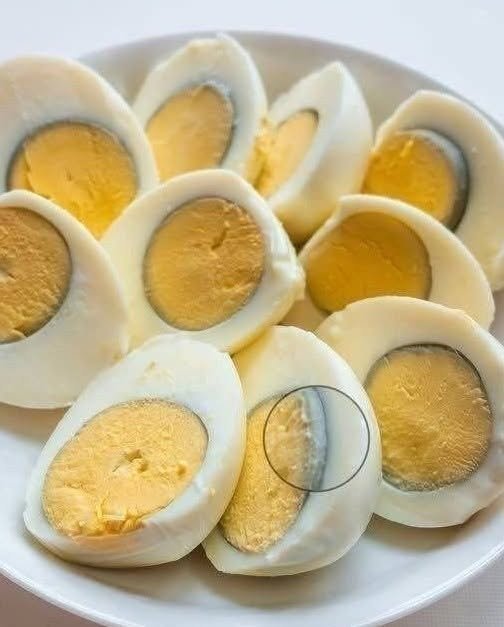
That classic kitchen mystery—peeling back the shell of a hard-boiled egg only to find a dull gray-green ring sitting right between the white and the yolk—looks alarming, but it is entirely harmless.
You haven’t bought a bad egg; you’ve just witnessed a classic piece of kitchen chemistry in action.
Here is why that green ring appears and how the cooking process causes it:
The Science Behind the Green Ring
-
Heat and Sulfur Interaction:
-
What happens: Eggs contain plenty of protein, and proteins are rich in amino acids that contain sulfur. When you heat an egg, the heat breaks down these sulfur-containing amino acids in the egg white, releasing hydrogen sulfide gas.
-
-
The Iron and Sulfur Dance:
-
What happens: As the egg continues to cook, that sulfur gas moves inward toward the center, seeking out the yolk. The egg yolk is packed with iron. When the migrating sulfur gas meets the iron on the surface of the yolk, they react to form iron sulfide.
-
-
The Visual Result:
-
What happens: That thin layer of iron sulfide is precisely what creates that distinct gray-green halo right where the white and yolk meet.
-
How to Prevent It (The Perfect Boil)
The green ring is caused by two things: overcooking and too much heat. When eggs are boiled too long, the sulfur reaction accelerates.
To get bright yellow yolks every time:
-
Don’t over-boil: Bring your water to a rolling boil, gently lower the eggs in, cover, and let them cook for precisely 9 to 11 minutes (depending on egg size).
-
The Ice Bath Shock: The absolute most important step is to plunge the cooked eggs immediately into a bowl of ice-cold water for at least 5 minutes. This rapidly drops the internal temperature, stopping the chemical reaction dead in its tracks and preventing the sulfur from migrating to the yolk. Plus, it makes them infinitely easier to peel!
Do you like your hard-boiled eggs with a firm, solid yolk, or do you prefer them a bit softer and jammy?
