Headlines announcing that “colonoscopy will no longer be an invasive examination” capture a lot of attention, but they oversimplify a major evolution in medicine.
Gastroenterologists and oncologists view recent developments not as the death of the traditional colonoscopy, but as the rapid expansion of non-invasive screening alternatives designed to get more people tested.
The primary hurdle preventing people from getting screened has always been the dread of the preparation, the sedation, and the physical procedure itself. Modern alternatives aim to bypass that barrier for average-risk individuals, though they come with distinct medical caveats.
What Are the True Non-Invasive Alternatives?
When medical technology offers non-invasive ways to check the colon, it typically falls into three primary categories:
-
1. Blood-Based Liquid Biopsies (The Newest Frontier):
-
How it works: Recent advancements have led to FDA-approved blood tests (such as cell-free DNA blood tests like Shield and SimpleScreen CRC) that look for circulating tumor DNA and molecular signals associated with colorectal cancer from a standard blood draw.
-
The Catch: While exceptionally convenient, blood tests are primarily designed to catch cancer rather than prevent it. They have lower sensitivity for detecting early-stage precancerous polyps compared to a physical scope.
-
-
2. At-Home Stool Tests (Cologuard or FIT):
-
How it works: Tests like the Fecal Immunochemical Test (FIT) or multi-target stool DNA tests (Cologuard) analyze stool samples at home for hidden traces of blood or altered DNA shed by growths.
-
The Catch: These must be repeated regularly (typically every 1 to 3 years).
-
-
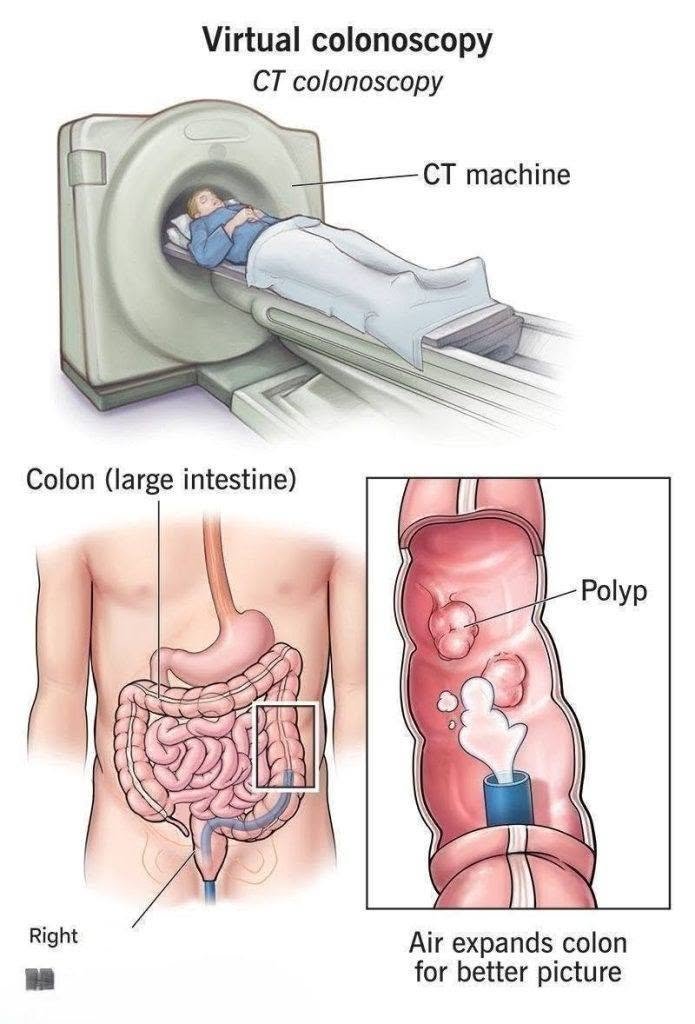
3. Virtual Colonoscopy (CT Colonography):
-
How it works: A specialized low-dose CT scan creates 3D images of the entire colon without inserting a scope or requiring sedation.
-
The Catch: It still requires a rigorous bowel-cleansing preparation beforehand, and if the radiologist spots a suspicious polyp, you still have to undergo a traditional colonoscopy anyway to have it removed.
-
Why the Traditional Colonoscopy Remains the Gold Standard
Even with exciting non-invasive breakthroughs, gastroenterologists emphasize why the traditional colonoscopy holds a unique place in medicine: it is both diagnostic and therapeutic.
-
The Removal Factor: Blood and stool tests can only tell you if something might be wrong. Imaging scans can show a shadow. But a traditional colonoscopy allows the physician to pass tiny surgical instruments through the scope and physically remove precancerous polyps (polypectomy) on the spot, effectively stopping cancer before it starts. Non-invasive tests cannot remove anything.
💡 The Big Takeaway
Non-invasive blood and stool tests are game-changers for closing the screening gap and making detection accessible to millions who would otherwise skip it entirely. However, they are triage tools, not total replacements. If a non-invasive test comes back positive—or if you are at high risk due to family history—a standard colonoscopy remains the definitive next step.
Are you exploring non-invasive screening options for yourself or a loved one, or were you evaluating a headline about a specific new test?
